
Central Nevada’s Emerging Tonopah Lithium Belt
Over the past decade, Nevada has become one of the most important regions in the world for lithium exploration. While attention has often focused on individual projects, a broader geological pattern is beginning to emerge in central Nevada: a growing corridor of lithium exploration surrounding the historic mining town of Tonopah.
This developing district—referred to here as the Tonopah Lithium Belt—includes several lithium exploration and development projects located within a relatively compact region of central Nevada. Together, these projects highlight the geological potential of the basin systems surrounding Tonopah and reinforce the region’s position in the emerging domestic lithium supply chain.
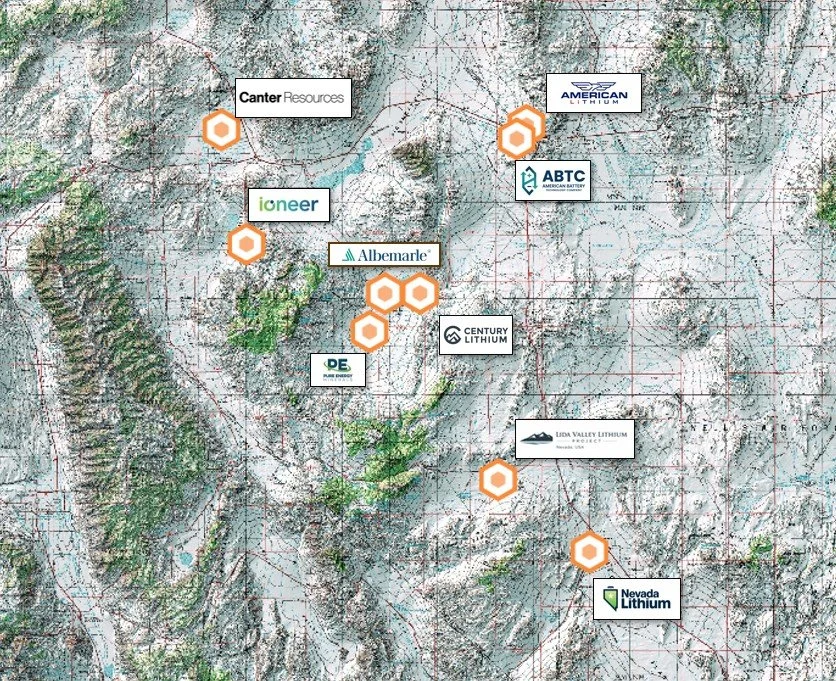
Figure 1. Map showing major lithium exploration and development projects forming the emerging Tonopah Lithium Belt in central Nevada.
Projects shown include operations by Ioneer Ltd., American Battery Technology Company, Pure Energy Minerals, Century Lithium, Canter Resources, and the Lida Valley Lithium Project. sourced from lidavalleylithium.com
A New Lithium District in Central Nevada
Tonopah is historically known for its rich silver deposits, which helped build one of Nevada’s most productive mining districts during the early 20th century. Today, however, the surrounding basins are attracting attention for a different resource: lithium hosted in sedimentary clay deposits and brine systems.
Several major lithium exploration and development projects now operate within the broader Tonopah region, forming what can be interpreted as an emerging lithium exploration belt within central Nevada.
Key projects within this emerging belt include:
Rhyolite Ridge Lithium-Boron Project
Clayton Valley, home to operations by Albemarle Corporation and exploration projects by Pure Energy Minerals and Century Lithium
Columbus Lithium Project
Tonopah Flats Lithium Project
Bonnie Claire Lithium Project
Lida Valley Lithium Project
These projects target a mix of lithium brine systems and lithium-bearing claystone deposits, reflecting the diverse geological processes that have concentrated lithium across central Nevada’s basin environments.
Why the Tonopah Lithium Belt Exists
The concentration of lithium projects surrounding Tonopah is not coincidental. The region sits within one of the most geologically favorable environments in North America for the formation of lithium-bearing basin deposits.
Central Nevada lies within the Walker Lane Structural Zone, a broad belt of transtensional deformation accommodating movement between the Pacific and North American tectonic plates. Over millions of years, this tectonic activity has produced numerous fault-bounded basins throughout western Nevada.
These basins are critical to lithium deposit formation because they act as natural traps where lithium-bearing sediments and fluids can accumulate and concentrate.
Basin Formation and Sediment Traps
During the Miocene and Pliocene, extension within the Basin and Range province created a series of closed internal drainage basins across central Nevada. Unlike river systems that drain to the ocean, these basins trapped water and sediment within internally drained lake environments.
Over time, erosion from surrounding volcanic highlands transported volcanic ash, clay, and fine sediments into these basins. As lake waters evaporated, lithium and other dissolved elements became concentrated within basin sediments and groundwater systems.
This process produced the lithium-rich clay and brine deposits now being explored across the region.
Volcanic Source Rocks
Another critical component of the Tonopah Lithium Belt is the abundance of nearby volcanic rocks. Miocene volcanic activity across western Nevada produced extensive ash-flow tuffs and rhyolitic volcanic units that often contain elevated lithium concentrations.
When these volcanic rocks weather, lithium can be released into groundwater and transported into basin environments where it becomes incorporated into clay minerals such as smectite and illite.
Many lithium claystone deposits in Nevada are believed to have formed through this combination of volcanic lithium sources and closed-basin sedimentation.
Structural Controls
Fault systems within the Walker Lane also play an important role in controlling basin geometry and groundwater flow. Fault-bounded basins create accommodation space for thick sequences of sediment and can influence the movement of mineralized fluids through basin fill.
These structural controls help explain why lithium deposits tend to occur in clusters of favorable basins rather than being evenly distributed across the region.
A Growing Belt of Lithium Exploration
What makes the Tonopah Lithium Belt particularly notable is not just the presence of lithium deposits, but the increasing concentration of exploration and development projects within the same geological corridor.
Clusters of mineral deposits often indicate favorable regional geology and shared mineralizing processes. Similar patterns have been observed in other major mining districts around the world.
Examples include:
The Carlin Trend
The Salar de Atacama
The Pilbara Region
Central Nevada may be developing a comparable district-scale lithium system centered around Tonopah.
Exploration Implications of the Tonopah Lithium Belt
Recognizing the Tonopah Lithium Belt as a regional geological system has important implications for exploration across central Nevada. Rather than viewing lithium occurrences as isolated deposits, geologists can evaluate the region as a series of related basin systems formed under similar tectonic and volcanic conditions.
Understanding the geological characteristics shared by productive lithium basins in this region may help guide exploration toward new discoveries within the broader Tonopah Lithium Belt.
Basin Architecture and Structural Controls
Most lithium deposits in central Nevada occur within fault-bounded basins formed during Basin and Range extension. These basins provide the accommodation space necessary for thick sequences of sediment to accumulate.
Exploration programs should prioritize basins that display:
Significant structural subsidence
Evidence of long-lived basin development
Thick sedimentary fill sequences
Fault systems capable of controlling groundwater flow
Structural mapping and geophysical surveys such as gravity and seismic data can help identify basins with the greatest potential for hosting lithium-bearing sediments.
Faults associated with the Walker Lane Structural Zone often play a critical role in defining basin geometry and may also influence the movement of mineralized fluids through basin fill.
Closed Basin Hydrology
Lithium accumulation is most efficient in closed basins with internal drainage, where water and dissolved elements remain trapped within the basin rather than being transported away by river systems.
In these environments, evaporation and chemical concentration within ancient lake systems can gradually enrich sediments and groundwater with lithium over long periods of geological time.
Exploration geologists should therefore focus on basins that show evidence of:
Ancient lacustrine environments
Evaporative lake systems
Thick sequences of fine-grained sediment
Sedimentological studies and drilling programs can help confirm whether a basin hosted the type of lake environments capable of concentrating lithium.
Volcanic Lithium Sources
Another key factor controlling lithium mineralization in Nevada basins is the presence of nearby volcanic source rocks.
Miocene volcanic activity across western Nevada produced extensive rhyolitic ash-flow tuffs and volcanic glass deposits that can contain elevated lithium concentrations. As these volcanic rocks weather, lithium can be released into groundwater and transported into adjacent basin environments.
Basins located near large volcanic centers or extensive ash-flow deposits may therefore have a greater likelihood of hosting lithium-bearing sediments.
Fine-Grained Lacustrine Sediments
Lithium clay deposits typically occur within fine-grained lacustrine sediments, including tuffaceous clays, altered volcanic ash layers, and clay-rich mudstones.
These sediments commonly accumulate in the deepest portions of basin environments, where low-energy conditions allow fine particles to settle.
Exploration drilling programs targeting lithium clay deposits should therefore focus on:
Thick sequences of clay-rich sediments
Altered volcanic ash layers within basin fill
Zones of strong clay alteration
Lithium concentrations in Nevada clay deposits are often associated with minerals such as smectite, illite, and hectorite, which can incorporate lithium within their crystal structures.
Geophysical Targeting
Because many basin centers are covered by alluvium, geophysical methods can play an important role in identifying favorable exploration targets.
Common geophysical tools used in lithium basin exploration include:
Gravity surveys, which help define basin depth and geometry
Magnetotellurics (MT) and resistivity surveys, which can detect conductive clay-rich sedimentary sequences
Seismic surveys, which help map basin stratigraphy and structural controls
Combining geophysical datasets with geological mapping can significantly improve drill targeting in early-stage lithium exploration programs.
Identifying New Exploration Targets
The Tonopah Lithium Belt concept suggests that additional lithium discoveries may occur in basins that share similar geological characteristics but remain underexplored.
Potential exploration targets within central Nevada may include:
Basins located along major structural corridors within the Walker Lane
Areas adjacent to known lithium-bearing volcanic source rocks
Basins containing thick sequences of lacustrine sediments that have not yet been drilled
As exploration activity continues across the region, these geological indicators may help guide future drilling programs toward new lithium discoveries within the Tonopah region.
Lithium Prices and the Future of the Tonopah Lithium Belt
Demand for lithium continues to increase as electric vehicles and energy storage technologies expand worldwide. The United States currently relies heavily on imported lithium, making domestic supply increasingly important. Recent lithium prices reflect the growing demand for battery materials. Battery-grade lithium carbonate equivalent (LCE) has recently traded in the $16,000–$23,000 per tonne range, recovering significantly from lows near $8,000–$9,000 per tonne in 2025. This rapid increase highlights the strong global demand for lithium used in electric vehicle batteries and energy storage systems. Higher lithium prices have renewed exploration activity across Nevada, particularly in regions such as the Tonopah Lithium Belt where favorable geology suggests the potential for large lithium resources. Several projects in the region are advancing toward development, while others remain in earlier exploration stages. Continued drilling, geophysical surveys, resource modeling, and metallurgical testing will determine which of these projects ultimately move toward production.
The emerging Tonopah Lithium Belt highlights how regional tectonics, volcanism, and basin development can combine to form clusters of mineral deposits within favorable geological settings. As exploration continues across central Nevada, the Tonopah region may increasingly be recognized not only for its historic precious metal deposits but also as one of North America’s most important lithium exploration districts. For geologists and exploration companies alike, the Tonopah Lithium Belt represents a compelling example of how district-scale geological processes can shape the future of mineral exploration and development.
Sources
Nevada Geological and Regional Geology
Nevada Bureau of Mines and Geology. Geology of Nevada and lithium resources in the Basin and Range Province.
U.S. Geological Survey.
Bradley, D., Stillings, L., Jaskula, B., Munk, L., & McCauley, A. (2017). Lithium in Clay Deposits of the United States. USGS Professional Paper.U.S. Geological Survey.
Jaskula, B. (2024). Mineral Commodity Summary: Lithium.
Lithium Basin and Claystone Research
Munk, L., Hynek, S., Bradley, D., Boutt, D., Labay, K., & Jochens, H. (2016).
Lithium brines: A global perspective. Reviews in Economic Geology.Benson, T., Coble, M., Rytuba, J., & Mahood, G. (2017).
Lithium enrichment in intracontinental rhyolite-related caldera basins. Economic Geology.
Regional Mining and Lithium Projects
Ioneer Ltd..
Rhyolite Ridge Lithium-Boron Project – Technical Reports and Investor Presentations.American Battery Technology Company.
Tonopah Flats Lithium Project – Resource and Pre-Feasibility Study materials.Century Lithium.
Angel Island Project – Clayton Valley lithium project disclosures.Pure Energy Minerals.
Clayton Valley Project technical reports.Canter Resources.
Columbus Lithium Project corporate presentations and exploration updates.
Lithium Market and Supply Chain
Benchmark Mineral Intelligence.
Lithium Price Assessments and Battery Supply Chain Reports.International Energy Agency.
Global Critical Minerals Outlook.
Regional Mining History
Nevada Division of Minerals.
Historical mining districts of Tonopah and Goldfield.
