

No Deposit Is a One-Mineral Deposit Anymore
For much of modern mining history, mineral deposits were described and marketed around a single commodity. A gold mine was a gold mine. A silver project was a silver project. A lithium deposit was simply a lithium deposit. But that framing is increasingly outdated.
Today, most mineral deposits are evaluated not as single-commodity systems, but as multi-element economic systems where several metals contribute to the overall value of the resource. As exploration techniques improve and commodity markets evolve, it has become clear that very few deposits are truly defined by only one metal.
In reality, almost every deposit contains multiple economically relevant elements—and modern project valuation reflects that.
The Rise of Equivalent Metals
One of the clearest indicators of this shift is the widespread use of metal equivalents in resource reporting.
Across the industry, exploration companies routinely present grades in terms such as:
Gold Equivalent (AuEq)
Silver Equivalent (AgEq)
Copper Equivalent (CuEq)
Zinc Equivalent (ZnEq)
Equivalent grades allow geologists and investors to express the total value of multiple metals contained within the same ore body. For example, a silver deposit may also contain significant lead, zinc, or gold. Rather than reporting each metal independently, the combined economic contribution can be expressed as a single equivalent grade. This approach reflects a simple economic reality: multiple metals often contribute to the profitability of a mine.
By-Products Often Make the Difference
In many mineral deposits, secondary metals can significantly impact project economics. While a deposit may be marketed around a primary commodity, the presence of additional recoverable metals often plays a critical role in determining whether a project is ultimately viable. These metals are commonly referred to as by-products, and their contribution can be substantial.
In polymetallic systems, by-products can generate additional revenue streams that offset the cost of mining and processing the primary metal. When incorporated into project economics, these credits can materially reduce the effective cost of production. For example, a silver deposit that also contains meaningful lead and zinc grades may generate revenue from those metals during processing. The value recovered from lead and zinc concentrates can significantly lower the net operating cost of producing silver. Similarly, many large copper deposits contain appreciable amounts of gold and molybdenum. While copper may be the primary commodity, these additional metals can contribute meaningful value to the operation. In some cases, gold credits alone can reduce the effective cost of copper production by a significant margin.
A well-known example of this dynamic is the Greens Creek Mine in Alaska. The mine is widely recognized as one of the world’s highest-grade silver operations, but its economic strength is supported by substantial production of zinc, lead, and gold. These by-products contribute significantly to overall revenue and help maintain the operation’s strong cost profile.
In many cases, the economic role of by-products becomes even more important as deposits move from exploration to development. Preliminary exploration programs may focus on a single commodity, but as drilling expands and metallurgical studies progress, additional metals are often incorporated into resource models and economic studies. This is why modern resource estimates and technical reports frequently present grades in terms of metal equivalents such as AgEq, AuEq, or CuEq. These calculations allow geologists and engineers to represent the combined economic contribution of multiple metals within a single deposit..
Understanding the potential contribution of by-products is therefore an essential part of evaluating any mineral system. What may initially appear to be a single-metal deposit often derives much of its economic strength from the additional metals contained within the same geological system.
Lithium Projects Are Following the Same Trend
The shift toward multi-element deposits is particularly visible in the rapidly growing battery metals sector.
Lithium projects are rarely just lithium anymore. Many lithium-bearing systems—particularly claystone and evaporite deposits—contain a broader suite of elements that were historically overlooked but are now receiving increased attention as potential contributors to project economics.
In continental basin settings, lithium is commonly associated with elements such as:
Boron (B)
Potassium (K)
Magnesium (Mg)
Sodium (Na)
These elements are not randomly distributed—they reflect the underlying geochemical processes that concentrate lithium in closed basin environments. Volcanic ash, hydrothermal fluids, and long-lived evaporative systems introduce and concentrate multiple elements simultaneously, resulting in multi-element brine or clay systems. A well-known example is Rhyolite Ridge in Nevada, where lithium and boron occur together in economic concentrations. In this case, the project is fundamentally defined by two commercially valuable commodities, not just one.
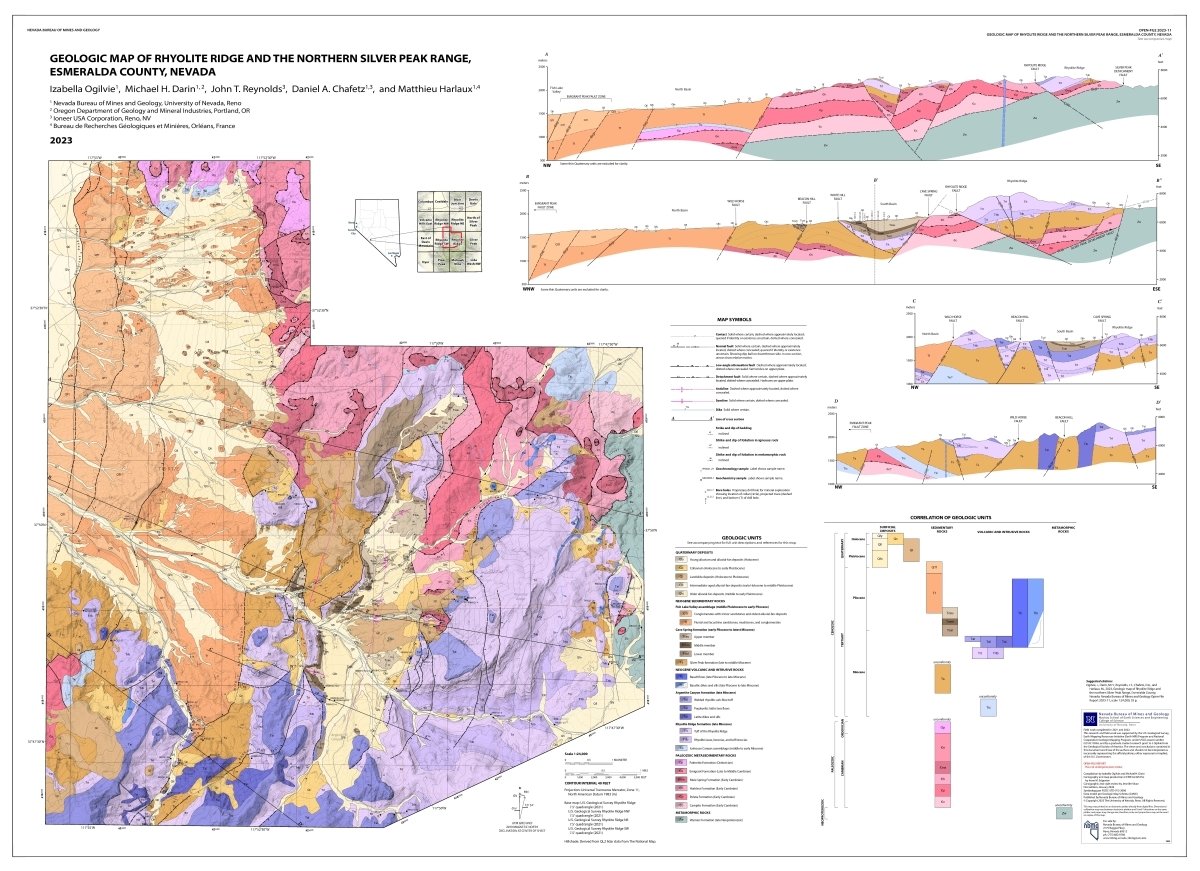
Geologic Map of Rhyolite Ridge where the Ioneer Lithium - Boron project is located
This has important implications for how lithium projects are evaluated.
Historically, many lithium exploration programs focused almost exclusively on lithium grades and tonnage. Today, there is increasing recognition that other elements present in these systems may represent additional value streams—either as co-products or as recoverable components during processing. In some cases, boron may be recoverable as a saleable product. In others, potassium or other elements may influence processing methods, reagent consumption, or overall recovery efficiency. Even when not directly recovered, these elements can still play a role in determining the economic and technical viability of a project. At the same time, advances in processing technology are making it more feasible to extract multiple elements from the same resource. As flowsheets evolve, the concept of a “lithium-only” operation becomes less representative of how these deposits may ultimately be developed.
This is particularly relevant in regions like Nevada, where large, long-lived basin systems have concentrated multiple elements over geologic time. Projects in these settings are increasingly being understood not just as lithium deposits, but as complex geochemical systems with the potential to produce multiple commodities. As the battery metals market continues to mature, this trend is likely to accelerate. Projects that can demonstrate value beyond lithium alone may be better positioned economically, particularly in an environment where development costs are rising and processing efficiency is critical.
In that context, lithium deposits are no longer just lithium deposits—they are part of broader multi-element systems whose full value is only realized when all economically relevant components are considered.
Common Economic Metal Associations in Ore Systems
Many ore deposits are formed by geological systems that concentrate groups of metals together. While exploration programs may initially target a single commodity, several associated metals often occur in grades high enough to contribute meaningfully to project economics.
These additional metals are frequently incorporated into metal equivalent calculations such as AgEq, AuEq, or CuEq when reporting resources.
Below are some of the most common economic metal associations seen across major deposit types.
Silver Systems
Silver deposits often contain significant base metal credits that are factored into AgEq calculations.
Common economic associations include:
Silver (Ag)
Lead (Pb)
Zinc (Zn)
Gold (Au)
Copper (Cu)
Many high-grade silver districts around the world operate as polymetallic mines where lead and zinc credits materially reduce operating costs. The Greens Creek Mine is a classic example where silver production is supported by substantial zinc, lead, and gold by-products.
Gold Systems
Gold deposits frequently contain metals that contribute to AuEq calculations, particularly in porphyry and polymetallic systems.
Common economic associations include:
Gold (Au)
Silver (Ag)
Copper (Cu)
Molybdenum (Mo)
In large porphyry systems, copper can dominate the revenue stream while gold and molybdenum contribute additional value that improves overall project economics.
Copper Systems
Copper deposits—particularly porphyries—are among the most economically diverse mineral systems.
Typical economic associations include:
Copper (Cu)
Gold (Au)
Molybdenum (Mo)
Silver (Ag)
These deposits are commonly reported in CuEq terms when gold and molybdenum grades are significant.
Zinc and Lead Systems
Base metal deposits such as SEDEX, VMS, and carbonate replacement systems often produce multiple metals simultaneously.
Common economic associations include:
Zinc (Zn)
Lead (Pb)
Silver (Ag)
Copper (Cu)
Gold (Au)
Because of this polymetallic nature, zinc or lead projects frequently report ZnEq grades incorporating silver and other metals.
Lithium Basin Systems
Lithium projects—particularly claystone and evaporite deposits—are increasingly evaluated as multi-element resources.
Common economic associations include:
Lithium (Li)
Boron (B)
Potassium (K)
One of the clearest examples is Rhyolite Ridge in Nevada, where both lithium and boron occur at economically meaningful grades within the same deposit.
As lithium markets evolve, additional elements recovered during processing may increasingly factor into project economics.
Modern Exploration Looks at Entire Systems
Historically, exploration programs were often designed with a single commodity in mind. A program might target gold veins, copper porphyries, or silver-bearing structures based primarily on the presence of that specific metal. Sampling programs, geophysical surveys, and drilling campaigns were frequently focused on answering one central question:
Is the target metal present in economic concentrations?
While that question still matters, modern exploration increasingly focuses on understanding the entire mineral system responsible for the deposit. Ore-forming processes rarely transport or deposit just one element. Hydrothermal fluids, magmatic systems, and basin brines typically carry complex mixtures of metals that precipitate together under specific pressure, temperature, and chemical conditions. As a result, most deposits represent the product of multi-element geochemical systems, not isolated metals.
Advances in analytical technology have accelerated this shift in perspective. Modern laboratories routinely analyze exploration samples for dozens of elements simultaneously, often using multi-element ICP-MS or ICP-OES techniques. Instead of receiving assay results for one or two metals, geologists now obtain large geochemical datasets that reveal the broader elemental signature of a mineralizing system.
These datasets allow exploration teams to do more than simply identify ore grades. They help geologists recognize patterns such as:
metal zonation within hydrothermal systems
geochemical halos surrounding ore bodies
relationships between alteration minerals and metal distribution
potential by-product metals that may add economic value
In many cases, these broader datasets reveal that a deposit contains additional metals that were not part of the original exploration target. At the same time, rising development and operating costs in the mining industry are making these additional metals increasingly important. The cost of bringing a project from exploration to production—including permitting, infrastructure, energy, labor, and environmental compliance—has increased significantly over the past several decades. Because of this, modern projects must generate stronger and more diversified revenue streams to remain economically viable. A project that might once have been evaluated purely as a silver deposit may ultimately depend on lead and zinc credits to improve margins. A copper porphyry may derive substantial value from gold or molybdenum. Lithium basin systems may reveal boron or potassium concentrations that could eventually contribute additional revenue alongside lithium production. Incorporating these metals into equivalent grade calculations—such as AgEq, AuEq, or CuEq—allows geologists and engineers to better represent the total economic value of the mineral system. As a result, exploration today is increasingly focused on understanding complete mineral systems rather than individual commodities. Geologists evaluate deposits based on the full suite of elements present, the geological processes that concentrated them, and the potential economic contribution of all recoverable metals within the system.
This systems-based approach not only improves exploration targeting—it also helps companies better understand the true economic potential of a project in an increasingly complex and costly mining environment.
The Future of Mining Is Multi-Metal
The shift toward multi-metal deposits is not a trend—it is a reflection of how mineral systems have always functioned, now understood with greater clarity and evaluated with greater precision. Across the industry, this reality is becoming increasingly visible. Resource estimates incorporate metal equivalents. By-product credits are central to project economics. Exploration programs generate multi-element datasets that reveal the full scope of mineral systems rather than isolated commodities. At the same time, rising development costs and more complex project requirements are placing greater pressure on deposits to deliver stronger and more resilient economic returns. In this environment, the ability to generate value from multiple metals is no longer a secondary consideration—it is often a fundamental requirement. Taken together, these factors are reshaping how projects are defined. What may be presented as a gold, silver, or lithium project is, in practice, a multi-metal system where the combined contribution of several elements determines its viability. The primary commodity may still drive the narrative, but it is rarely the sole driver of value.
For geologists, this reinforces the importance of understanding complete mineral systems—how they form, how metals are distributed within them, and how those metals can be recovered. For developers and investors, it highlights the need to evaluate projects based on total economic potential rather than a single headline metal. The industry is not moving toward multi-metal deposits—it is recognizing that it has always been operating within them. And moving forward, the projects that succeed will be those that fully understand and capture the entire value of the systems they represent.
No deposit is a one-mineral deposit anymore.
